All GPS tracking devices, including GPS tracking watches, work around a few basic geometric principles. These principles are described by the trilateration equation. Trilateration uses the know location of two or more points of reference (the more the better) and the measured distance between the subject and the reference points to give an exact location for the subject. To aid our understanding of this geo-speak, take a look at the two dimensional example below:
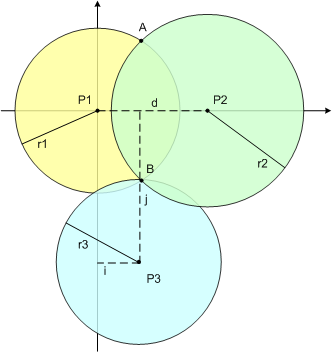
You are standing at point B in this picture (found where all three circles intersect). Let us imagine that you are standing out in the middle of nowhere and you want to find out where ‘here’ is. On your wrist is your GPS tracking watch, ready for instances just like this one. P1, P2, and P3 represent satellites in the NAVSTAR GPS constellation run by the US Government. There are twenty-four of these satellites orbiting approximately 12,600 miles (20,200 km) above the earth surface that are constantly transmitting microwave signals. At the same exact time, these satellites transmit a signal with information concerning their current location and the time that they were transmitted. The colored circles represent the path of the signal from the satellite at a specific time, let us say 8:45:03 AM, August 5, 1991.
Your GPS tracking device is designed to pick up these signals and record the time at which they arrive. Because the signals from the satellites travel at approximately the speed of light, knowing the difference between when the signal was generated and when your watch picks it up will let you know the distance between you and the broadcasting satellite. This is a very simple physics equation (speed x time = distance). When you combine this with the known location of each of the satellites (this information is contained in the signal that your watch picks up) your GPS tracking device has all the information it needs to give you an exact location for where you are.
GPS Tracking Is More Than Trilateration
Your GPS tracking watch will then do something with this new found information. If your watch is a data logger it will simply log your location in its memory and possibly give you a display of your longitude, latitude, and altitude. Data loggers are often simple devices that are used by bikers, hikers, and joggers to record their journeys, track the distances traveled for training purposes, or to build maps or guides if they are exploring new territory. This type of device has many useful applications, but unless you have a map with you in the middle of nowhere (Point B) this type of information will do you no good. If you are every stranded in some nondescript Point B I hope that you don’t have a data logger.
Instead, you want a tracking device that is going to be a data pusher. What these GPS devices do is they transmit their position information at specified intervals to a central database. This database can often be accessed through the internet, providing valuable information to the search party looking for you. Common applications of data pushers include tracking delivery vehicles, locating stolen property (LoJack), or keeping tabs on an object’s or individual’s location. Data pushers are extremely powerful because of the information they provide – but with this power also comes significant risk of abuse. The most common form of data pushing devices are used for GPS tracking are cell phones.
I hope that was a fairly straight forward explanation of how GPS tracking watches work. It was fairly simplified, so if you are interested in finding out more about the complex mechanics I would recommend checking out the following articles:
- Global Positioning System from Wikipedia
- Satellite Navigation a paper discussing the history and workings of GPS technology
How To Teach Your Kids About How GPS Works
When teaching your child about their kids GPS, you are going to want to find a way to relate the information in a way that they can understand. It doesn’t matter what type of GPS you are using with your child – it could be a short range child locator, a GPS tracking watch, or even a covert GPS tracking device – you just need to find a way to give your child a way to wrap their mind around the idea.
A basic understanding of math is always a good thing to have, but if your child is too young to fully grasp things like geometry they might be old enough to measure things. If you are in this situation, this quick activity may help you out:
- Grab a couple of paper plates out of your pantry.
- Draw a few satellites in the center of each paper plate. This will be a great time to explain what a satellite is and how they fly in the sky around the earth. You can make sure that they know that satellites make up the Global Positioning System (GPS).
- Arrange the paper plates so that they resemble the picture found above.
- Take out a ruler and measure the distance between each ‘satellite.’ Take the time to explain how this is important for the child locator that they get to use every day.
- Now explain that the child locator knows exactly where the satellites are in the sky around the earth. It can measure where the child is just like you did together with the ruler.
- Now take out your cell phone or your child’s GPS kids phone. Explain that their GPS device for kids works in the same way the phone does – it talks through the air to another phone. That is exactly what the kids GPS does – it talks through the air to someone else.
- And finally, tell them that the person that the GPS tracking watch talks to also talks to Mom and Dad. That is how you know that the child locator works and why you got it for them.
Most importantly of all, you want your child to fell like they are safe with their GPS tracking watch and that it makes them valuable/special. This will give them a better understanding of the world that they live in and will enable them to be productive little guys.
please help .. I called griman and they are only techs.. I am Tony TheFatLossExpert and i design my programs by heart rate, do you know if this watch will allow me to design laps around heart rate.. if i can record a lap and repeat it with a programmed heart rate alert zone to keep that same pace? thanks
Hi Tony,
I don’t know of any watch that uses heart rate as an alert for a run. You can certainly record your heart rate with something like a Garmin which you can then use to better understand your workout, but that doesn’t seem to be what you are looking for.
– Joe